Tuesday, October 21, 2014

Eye Candy

Image by Michael Nave.  Photo posted ==>HERE<===

Michael Nave is a chestnut grower in California.  He posts on on The Chestnut Forum.  He is very generous with his knowledge.

Grams per nut -to- Nuts per pound


Some people think in terms of grams per nut, or grams per sample of three nuts (the typical number of nuts in a chestnut burr).  Other people are more comfortable thinking in terms of nuts per pound. 

The table shown above is a way to switch between grams/nut sample to nuts per pound.  For example, the three nut sample in the top photo weighs 122 grams.  If that is representative of all nuts in the population than one would expect between 10 and 12 nuts to the pound.


Quercus robur or petraea?

For a long time I was under the delusion that there was only one species of temperate, Western European oak:  Quercus robur.

I was wrong.

Quercus robur is the oak of the deep, rich soils and protected coves of Western Europe...the cozy Western Europe of Thomas Hardy.  Quecus petraea is the oak of the shallow soil, of windy exposed knobs and of stony, acidic soil.  That would be the western Europe of the Bronte sisters and the Hounds of Baskerville.

===>This essay<=== explains how to determine if an oak specimen is Q. robur, Q. petraea or a nominal hybrid between the two.

Six specimens collected form my property. Roughly sorted, more robur like on bottom-right corner, more petraea like in upper-left corner.
Bottom right specimen: Petiole and auricles suggest pure Q. robur

Top-middle specimen, longish (9% of leaf length) petiole and lack of auricles suggests that this specimen is not pure Q. robur.
The reason I  hedge my bets and say "...not pure Q. robur" is that these specimens were from seeds collected  in Michigan and potential pollen parents also include Q. alba, Q. bicolor, Q. macrocarpa and Q. muhlenburgii as well as Q. petraea from the originating source in Europe.

Tuesday, October 7, 2014

Asian Chestnut Gall Wasp

As I planned for next year's planting and grafting season I found myself reminded of the Asian Chestnut Gall Wasp.


I live in Michigan and it is illegal to import chestnut trees or scionwood from states known to harbor Asian Chestnut Gall Wasps.

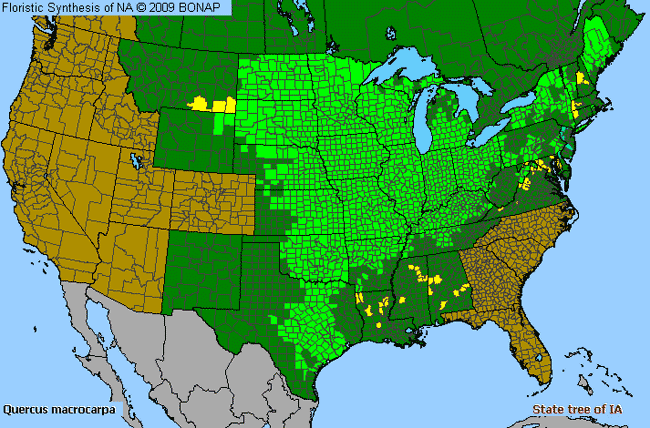
Light green is the natural range of the American Chestnut before the Chestnut blight showed up.
A list of states with documented populations of ACGW include:
  • Georgia, 
  • Alabama, 
  • North Carolina
  • Virginia
  • Maryland
  • Pennsylvania
  • Maryland
  • Kentucky
  • Tennessee
  • Ohio
  • Connecticu
  • Ontario, Canada 

Controls


The first line of defense is to not import it.  If in doubt, don't.

The second line of defense is sanitation. If it looks like it has galls, cut and burn the infected material.  Call your extension agent if you are in a state that is not documented as a ACGW positive state for positive identification.

The third line of defense is a cluster of parasitic wasps: Torymus sinensis, T. tubicola, Megastigmus

Native parasitic wasps are being identified as well.  These native species have not been effective in suppressing populations because they are not synchronized with peak ACGW vulnerability.  This situation is similar to what is seen with the Emerald Ash Borer.  Given time it is likely that a genetic shift will occur so native species can exploit this bonanza of potential hosts. 


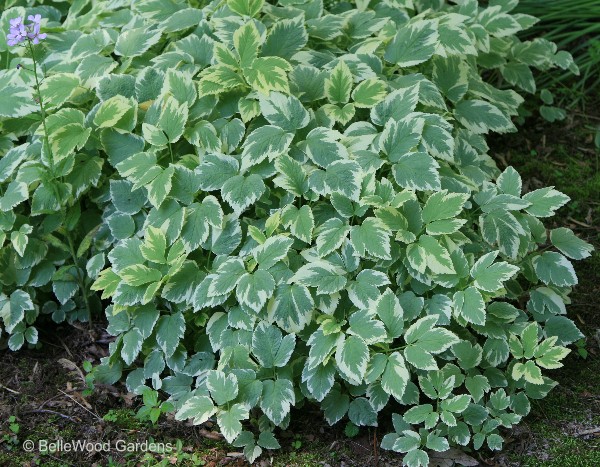
One thing that growers can do is to plant prime nectar sources in or near their trees to hit the end-of-May to middle-of-July time window so the parasitic wasps can maximize their time spent hunting the target, ACGW.  More research needs to be done to identify prime nectar sources. Potential plants include Mints, common white clover, sweet alyssum, Aegopodium podagraria,  and possibly Eupatorium perfoliatum if you can find an early blooming race.  These nectar plants are suggestions.

Composites (Dandelion?) and Umbelliferae are highly regarded nectar sources but they may be more difficult to integrate them into your orchard management plan as easily as white clover and sweet alyssum.  Beekeepers tell me that common garden raspberries and rhubarb attract vast swarms of native insects.  The rhubarb is a bit early for our purposes but the raspberries fall within the early part of the sweet spot.  No information is available regarding best cultivars although one would expect more berries to be correlated with more blossoms.

To reiterate, there may be relatively few native parasitic wasps that have populations peaks that coincide with when the ACGW is most vulnerable.  Literature suggests that optimum feeding of parasitic wasps can increase their life span by a factor of three-to-five times.  That increases the breeding efficiency of those races/species of wasps life cycles that do align with the ACGW, will hasten the speed of the genetic shift that will result in synchronization with the ACGW and by slowing down parasitic wasp mortality will increase the number of parasitic wasps per unit of land during periods of peak ACGW vulnerability.


Sunday, August 10, 2014

Internal Kernel Breakdown (Chestnuts)

A news release from Michigan State University:

We have recently found that a type of kernel rot, not associated with a mold or insect, is found in about 30% of the nuts from ‘Colossal’ trees when those trees are pollinized by Chinese chestnut....we strongly suggest keep Chinese cultivars from pollinizing ‘Colossal’.  At this time we are not sure if this affliction will show up in all European/Japanese hybrids and if all Chinese chestnuts cause it.  To be safe we suggest keeping European/Japanese hybrid and Korean (Japanese) cultivars 500 to 1000 feet away from sources of Chinese chestnut.

Source

Wednesday, August 6, 2014

Synchronized Bearing

Many species of fruit and nut trees tend to "alternate" bearing.  A more precise term is "synchronized" bearing because the years of heavy bearing are not always on a two year cycles.

Not all individuals in a give species show synchronized bearing traits.  That tells us that there must be some significant selection advantage to synchronized bearing in those species where most individuals do exhibit sychronized bearing.

Environmental factors that contribute to synchronized bearing


Specimens that have fully exploited the nutrients in their root zone tend to be more strongly synchronized.  The specimen will set an enormous crop.  The maturing crop sucks an enormous amount of both carbohydrates and nitrogen (protein) out of the tree.  The summer buds "decide" to take the vegetative form based on the dearth of resources needed to ripen next years crop.  Depending on the site and climate it may take several years before the tree "triggers" another mammoth crop.

Commercial fruit growers have bills to pay every year.  They overcome "alternate" bearing tendencies by managing the crop load.  They also manage fertility and soil moisture to ensure moderate annual shoot extension and a high-but-balanced level of Nitrogen and carbohydrates.

The cycle is often synchronized by a synchronizing event like a late freeze or a serious drought.

But WHY?


What advantage might a species gain by having most individuals having one (or several) years of no seed production followed by a bumper crop?  Specimens of synchronized bearing and annual bearing tendencies both exist within a given species.    Under conditions that strongly favor annual bearing one would expect synchronized bearing individuals to be rare.  There must be compelling reasons that favor individuals with synchronize bearing characteristics.

The leading theory for synchronized bearing is predator avoidance.  Trees cannot flee weevils.  They are rooted to the ground.  The effect of several years of not bearing is to starve out those insects that would otherwise come to an equlibrium with the food base if the trees were to bear annually.  The greatly diminished  population of pests cannot find and infest all of the nuts, or fruit, of those infrequent, massive crops.

Some pests can infest many different species.  The different species sharing a give habitat often follow their own synchronized schedule.  So how does the "predator avoidance" theory mesh with the messiness of multiple species?


They mesh rather elegantly, actually.  Each plant species typically has a different time window of maximum vulnerability.  A peak crop of a plant species with a late window will drag the timing of (i.e., genetically shift) the pest to peak later in the season.  Consequently, the peak pest pressure will miss the window of maximum vulnerability for earlier species.  In a similar way a peak crop of a very early species will shift the peak pest pressure to earlier in the season thereby clearing the way for later species.

Is there any evidence?


There is anecdotal evidence that some of the selections most notable for annual bearing (McDaniel's burenglish oak) also appear to be one of the most susceptible to weevils. 

Tuesday, June 24, 2014

Quercus shumardii?

Hello all:

I did not get this job because I am a wizard at Oaks and Chestnuts.  Rather.  I got this job because I had a little extra time and volunteered.

I want to tap the collective expertise out there on the internet.

This specimen is outside the normal range of Q. shumardii.

Specimen collected from "red speck" in northwest Ingham County, Michigan.  Base map from HERE.
Specimen from bottomland hardwoods.  Fellow trees include Burr Oak, Beech, Red Maple and Cottonwood.  Specimen first gained attention due to its persistent acorns.

Lobations not as deep as classic Q. shumardii.  This is a big leaf for a mature tree.  Photo taken on 8 1/2 by 11 sheet of paper.
Tufts of fuzz in crotch between mid-rib and veins is not typical of Northern Red Oak.

Another shot but closer to the tip.
This tree has a boat load of acorns on it so it was pollinated by something.  I took photos of acorns but failed to have a memory card in the camera 8-(.

I need your help.  What do you guys think?  Q. shumardii?  Atypical Q. rubra?  Q. rubra with introgression of some Q. shumardii genes?

Thursday, May 29, 2014

Legacy Trees (Burr Oak)

One of the appeals of planting oak trees is that there is a very real possibility that a tree you plant could still be giving pleasure to people two or even three hundred years from now.

Some genus are more suited for "legacy trees" than others.  Oak are a great choice because they are long lived trees, can grow to impressive size and offer benefits beyond simply producing shade.

I am not an unbiased observer.  I think that Burr Oak (Quercus macrocarpa) is one of the finest species within the genus...at least in the Northeast United States.  Here are my reasons:

Legacy trees must be able to fend for themselves.  There is no guarantee that all of the property owners over the next three hundred years will be "tree huggers"  Burr Oak are probably the most fire resistant tree in the Northeast United States.  Burr Oak are the oak trees of the tall grass prairie Oak Savannahs. Those savannahs were maintained by regular burns that killed off the Box Elder, Red Maple and other invading species.


If you suspect that your planting may be exposed to "burns", then it makes sense to select seedlings with "corky" 2nd year bark.  Cull the rest or give them to friends.

The more I look at individual oak trees the harder it gets for me to pigeon hole them into a species.  This tree has characteristics of both Swamp White Oak (Q. bicolor) and Burr Oak.  Growing in a sedge marsh with cattails, sedge and willow.  Growing beside Canfield Rd, Eaton County, Michigan.

Burr Oak in a flood plain beside Nye Hwy.  Other side of road is willow, cottonwood, elderberry and Reed Canary grass.  Understory here is primarily Giant Ragweed.

Burr Oak are moderately-to-highly tolerant of flooding.  My personal belief is that different land races of Burr Oak have varying degrees of tolerance to flooding.  Flooding depletes the soil of oxygen.  Paving and compaction have a similar effect.

Young Burr Oak showing persistent "whiskers".  Beside Gunnell Rd, Eaton County, Michigan
Older Burr Oak showing persistent "whiskers".  5 Point Hwy, Eaton County, Michigan.

Burr Oak have an abundance of small, persistent side branches.  These small branches lower the value of the tree for lumber and make it much more difficult to split for firewood.  Those kinds of "blemishes" reduce the likelihood that the tree will be "poached" because of its lesser value or because it is simply more work to burn.


There is much genetic diversity within the species.  It ranges from Maine to Montana, Alabama (nice specimen next to the College of Veterinary Medicine at Auburn) and southern Texas to Manitoba.

The abundance small, persistent side branches also make the tree more likely to survive a lightening strike.  The tree may be killed down one side or may be killed to within 15 feet of the ground, but those persistent side branches means that the tree will recover.  In addition to the persistent side branches, the heart wood is quite rot resistant which allows the tree to heal over the injuries. Rot resistant wood also makes hollow Burr Oak a rarity...helping them resist wind storms even in their dottage.

I know I am fixating on a "Legacy tree's" need to shrug off insults and adversity.  A good primer for the kinds of challenges that "Legacy trees" must endure can be gleaned by studying The Endicott Pear, one of this nation's best documented trees.


Most Burr Oak have a classic, forest tree form.  Many "Champion" trees are grotesque, warped trees that scored well.  Many, many Burr Oak look like the McBaine Oak, a former National Champion.

The downside


Many Burr Oak retain their leaves into the winter which makes them more vulnerable to ice damage.  This trait is most pronounced when the tree is juvenile and abates, somewhat, as the tree matures.

Of the oaks in the White Oak group, Burr Oak is reputed to be the most susceptible to Oak Wilt.  It is still more resistant than any of the species in the Red Oak group.

Many Burr Oak produce exceptional amounts of acorns.  This is a great thing if you are interested in oak as a food crop or if you want to feed wildlife.  The downside is that the energy that could be going into growing height and girth...outcompeting its neighbors is diverted into producing acorns.  How many of you have stumbled across an ancient apple orchard overgrown by elm, ash, wild cherry and Red Oak?  The weight of the fruit bends the branches down.  The apples simply cannot grow tall enough to fend for themselves if the orchard is left unattended for even thirty years.  Some Burr Oak selections also seem to be vulnerable to having their branches dragged down by bumper crops.

Bottom Line


If you are planting trees to establish a legacy you could do far worse than to plant a grove of Burr Oak (Q. macrocarpa) or its hybrids.  You can improve the odds of the trees you planted surviving many hundreds of years if you select seeds from waterlogged sites, grow them for three years and select for corky bark (a desirable trait).  Selecting for earliest winter leaf fall within the seedling population will decrease vulnerability to ice damage and is somewhat correlated with greater winter hardiness.  Rogue out all seedlings that show leaf diseases like powdery mildew.

Choose a site with suitable fertility.  Inter-plant the Burr Oak with other, non-oak species to achieve a total plant density of about 400-to-500 trees per acre (about 10'-by-10' or 3m-by-3m spacing).  The goal is to reduce the density of trees that are vulnerable to Oak Wilt.  A reasonable starting point is to start with 25% of the trees (100 per Burr Oak per acre) as Burr Oak with a mind to ending up with a final population of 20-to-30 Burr Oak per acre.

One source proposes some of the following species as "pioneer" species.  These might be good plants to use as some of the "non-oak species" because they will self extinguish and some of them will add nitrogen, attract wildlife or have other advantages.
  • Alder (fixes nitrogen)
  • Birch (live hard, die young, leave a good looking corpse)
  • Apples and Crabapples
  • Pears
  • Mulberry
  • Chokecherry
  • Sumac
  • Locust (Black Locust fixes nitrogen and is good firewood and fence posts)
  • Willow. Many species available.  S. alba, S. fragilis and S. matsudana become large trees.  S. nigra and S. amygdaloides tend to be somewhat smaller. Most other willow species are shrubby...to 20 feet tall.
  • Box Elder (or the more ornamental Asian equivalents A. ginnala, A. buergerianum)
  • Tree dogwoods (C. florida, C. mas, C. kousa)
  • Aspen
  • Yaupon