Sunday, August 10, 2014

Internal Kernel Breakdown (Chestnuts)

A news release from Michigan State University:

We have recently found that a type of kernel rot, not associated with a mold or insect, is found in about 30% of the nuts from ‘Colossal’ trees when those trees are pollinized by Chinese chestnut....we strongly suggest keep Chinese cultivars from pollinizing ‘Colossal’.  At this time we are not sure if this affliction will show up in all European/Japanese hybrids and if all Chinese chestnuts cause it.  To be safe we suggest keeping European/Japanese hybrid and Korean (Japanese) cultivars 500 to 1000 feet away from sources of Chinese chestnut.

Source

Wednesday, August 6, 2014

Synchronized Bearing

Many species of fruit and nut trees tend to "alternate" bearing.  A more precise term is "synchronized" bearing because the years of heavy bearing are not always on a two year cycles.

Not all individuals in a give species show synchronized bearing traits.  That tells us that there must be some significant selection advantage to synchronized bearing in those species where most individuals do exhibit sychronized bearing.

Environmental factors that contribute to synchronized bearing


Specimens that have fully exploited the nutrients in their root zone tend to be more strongly synchronized.  The specimen will set an enormous crop.  The maturing crop sucks an enormous amount of both carbohydrates and nitrogen (protein) out of the tree.  The summer buds "decide" to take the vegetative form based on the dearth of resources needed to ripen next years crop.  Depending on the site and climate it may take several years before the tree "triggers" another mammoth crop.

Commercial fruit growers have bills to pay every year.  They overcome "alternate" bearing tendencies by managing the crop load.  They also manage fertility and soil moisture to ensure moderate annual shoot extension and a high-but-balanced level of Nitrogen and carbohydrates.

The cycle is often synchronized by a synchronizing event like a late freeze or a serious drought.

But WHY?


What advantage might a species gain by having most individuals having one (or several) years of no seed production followed by a bumper crop?  Specimens of synchronized bearing and annual bearing tendencies both exist within a given species.    Under conditions that strongly favor annual bearing one would expect synchronized bearing individuals to be rare.  There must be compelling reasons that favor individuals with synchronize bearing characteristics.

The leading theory for synchronized bearing is predator avoidance.  Trees cannot flee weevils.  They are rooted to the ground.  The effect of several years of not bearing is to starve out those insects that would otherwise come to an equlibrium with the food base if the trees were to bear annually.  The greatly diminished  population of pests cannot find and infest all of the nuts, or fruit, of those infrequent, massive crops.

Some pests can infest many different species.  The different species sharing a give habitat often follow their own synchronized schedule.  So how does the "predator avoidance" theory mesh with the messiness of multiple species?


They mesh rather elegantly, actually.  Each plant species typically has a different time window of maximum vulnerability.  A peak crop of a plant species with a late window will drag the timing of (i.e., genetically shift) the pest to peak later in the season.  Consequently, the peak pest pressure will miss the window of maximum vulnerability for earlier species.  In a similar way a peak crop of a very early species will shift the peak pest pressure to earlier in the season thereby clearing the way for later species.

Is there any evidence?


There is anecdotal evidence that some of the selections most notable for annual bearing (McDaniel's burenglish oak) also appear to be one of the most susceptible to weevils. 

Tuesday, June 24, 2014

Quercus shumardii?

Hello all:

I did not get this job because I am a wizard at Oaks and Chestnuts.  Rather.  I got this job because I had a little extra time and volunteered.

I want to tap the collective expertise out there on the internet.

This specimen is outside the normal range of Q. shumardii.

Specimen collected from "red speck" in northwest Ingham County, Michigan.  Base map from HERE.
Specimen from bottomland hardwoods.  Fellow trees include Burr Oak, Beech, Red Maple and Cottonwood.  Specimen first gained attention due to its persistent acorns.

Lobations not as deep as classic Q. shumardii.  This is a big leaf for a mature tree.  Photo taken on 8 1/2 by 11 sheet of paper.
Tufts of fuzz in crotch between mid-rib and veins is not typical of Northern Red Oak.

Another shot but closer to the tip.
This tree has a boat load of acorns on it so it was pollinated by something.  I took photos of acorns but failed to have a memory card in the camera 8-(.

I need your help.  What do you guys think?  Q. shumardii?  Atypical Q. rubra?  Q. rubra with introgression of some Q. shumardii genes?

Thursday, May 29, 2014

Legacy Trees (Burr Oak)

One of the appeals of planting oak trees is that there is a very real possibility that a tree you plant could still be giving pleasure to people two or even three hundred years from now.

Some genus are more suited for "legacy trees" than others.  Oak are a great choice because they are long lived trees, can grow to impressive size and offer benefits beyond simply producing shade.

I am not an unbiased observer.  I think that Burr Oak (Quercus macrocarpa) is one of the finest species within the genus...at least in the Northeast United States.  Here are my reasons:

Legacy trees must be able to fend for themselves.  There is no guarantee that all of the property owners over the next three hundred years will be "tree huggers"  Burr Oak are probably the most fire resistant tree in the Northeast United States.  Burr Oak are the oak trees of the tall grass prairie Oak Savannahs. Those savannahs were maintained by regular burns that killed off the Box Elder, Red Maple and other invading species.


If you suspect that your planting may be exposed to "burns", then it makes sense to select seedlings with "corky" 2nd year bark.  Cull the rest or give them to friends.

The more I look at individual oak trees the harder it gets for me to pigeon hole them into a species.  This tree has characteristics of both Swamp White Oak (Q. bicolor) and Burr Oak.  Growing in a sedge marsh with cattails, sedge and willow.  Growing beside Canfield Rd, Eaton County, Michigan.

Burr Oak in a flood plain beside Nye Hwy.  Other side of road is willow, cottonwood, elderberry and Reed Canary grass.  Understory here is primarily Giant Ragweed.

Burr Oak are moderately-to-highly tolerant of flooding.  My personal belief is that different land races of Burr Oak have varying degrees of tolerance to flooding.  Flooding depletes the soil of oxygen.  Paving and compaction have a similar effect.

Young Burr Oak showing persistent "whiskers".  Beside Gunnell Rd, Eaton County, Michigan
Older Burr Oak showing persistent "whiskers".  5 Point Hwy, Eaton County, Michigan.

Burr Oak have an abundance of small, persistent side branches.  These small branches lower the value of the tree for lumber and make it much more difficult to split for firewood.  Those kinds of "blemishes" reduce the likelihood that the tree will be "poached" because of its lesser value or because it is simply more work to burn.


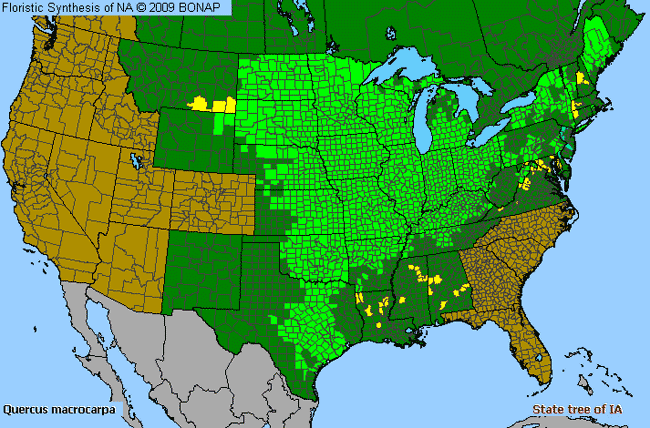
There is much genetic diversity within the species.  It ranges from Maine to Montana, Alabama (nice specimen next to the College of Veterinary Medicine at Auburn) and southern Texas to Manitoba.

The abundance small, persistent side branches also make the tree more likely to survive a lightening strike.  The tree may be killed down one side or may be killed to within 15 feet of the ground, but those persistent side branches means that the tree will recover.  In addition to the persistent side branches, the heart wood is quite rot resistant which allows the tree to heal over the injuries. Rot resistant wood also makes hollow Burr Oak a rarity...helping them resist wind storms even in their dottage.

I know I am fixating on a "Legacy tree's" need to shrug off insults and adversity.  A good primer for the kinds of challenges that "Legacy trees" must endure can be gleaned by studying The Endicott Pear, one of this nation's best documented trees.


Most Burr Oak have a classic, forest tree form.  Many "Champion" trees are grotesque, warped trees that scored well.  Many, many Burr Oak look like the McBaine Oak, a former National Champion.

The downside


Many Burr Oak retain their leaves into the winter which makes them more vulnerable to ice damage.  This trait is most pronounced when the tree is juvenile and abates, somewhat, as the tree matures.

Of the oaks in the White Oak group, Burr Oak is reputed to be the most susceptible to Oak Wilt.  It is still more resistant than any of the species in the Red Oak group.

Many Burr Oak produce exceptional amounts of acorns.  This is a great thing if you are interested in oak as a food crop or if you want to feed wildlife.  The downside is that the energy that could be going into growing height and girth...outcompeting its neighbors is diverted into producing acorns.  How many of you have stumbled across an ancient apple orchard overgrown by elm, ash, wild cherry and Red Oak?  The weight of the fruit bends the branches down.  The apples simply cannot grow tall enough to fend for themselves if the orchard is left unattended for even thirty years.  Some Burr Oak selections also seem to be vulnerable to having their branches dragged down by bumper crops.

Bottom Line


If you are planting trees to establish a legacy you could do far worse than to plant a grove of Burr Oak (Q. macrocarpa) or its hybrids.  You can improve the odds of the trees you planted surviving many hundreds of years if you select seeds from waterlogged sites, grow them for three years and select for corky bark (a desirable trait).  Selecting for earliest winter leaf fall within the seedling population will decrease vulnerability to ice damage and is somewhat correlated with greater winter hardiness.  Rogue out all seedlings that show leaf diseases like powdery mildew.

Choose a site with suitable fertility.  Inter-plant the Burr Oak with other, non-oak species to achieve a total plant density of about 400-to-500 trees per acre (about 10'-by-10' or 3m-by-3m spacing).  The goal is to reduce the density of trees that are vulnerable to Oak Wilt.  A reasonable starting point is to start with 25% of the trees (100 per Burr Oak per acre) as Burr Oak with a mind to ending up with a final population of 20-to-30 Burr Oak per acre.

One source proposes some of the following species as "pioneer" species.  These might be good plants to use as some of the "non-oak species" because they will self extinguish and some of them will add nitrogen, attract wildlife or have other advantages.
  • Alder (fixes nitrogen)
  • Birch (live hard, die young, leave a good looking corpse)
  • Apples and Crabapples
  • Pears
  • Mulberry
  • Chokecherry
  • Sumac
  • Locust (Black Locust fixes nitrogen and is good firewood and fence posts)
  • Willow. Many species available.  S. alba, S. fragilis and S. matsudana become large trees.  S. nigra and S. amygdaloides tend to be somewhat smaller. Most other willow species are shrubby...to 20 feet tall.
  • Box Elder (or the more ornamental Asian equivalents A. ginnala, A. buergerianum)
  • Tree dogwoods (C. florida, C. mas, C. kousa)
  • Aspen
  • Yaupon

Tuesday, May 27, 2014

Filberts

My brother Phil loves filberts.  Go figure.

At one time we had about 20 bushes on my dad's property.  All but two succumbed to the Eastern Filbert Blight.  One has symptoms and is barely hanging on.  The other is growing well after the variety that was grafted on top perished.  Phil remembered the day when he could fill a bucket by stripping the nuts from two bushes.  He asked me what it would take to bring back the filberts. This essay is my answer to Phil.

Roger Miller of Eaton Rapids, Michigan is very sour on filberts.  At one time he had 165 very productive bushes.  He is down to six.  Once again, devastated by the Eastern Filbert Blight. In the case of Roger's planting, he now has the nucleus of a planting from parents of proven, EFB resistant parents.  It is hard to tell if he has the stomach to start over.  But he has the parents....if he does.

This paper is a good overview of the current state of hazelnuts for the Eastern United States.

The National Arbor Day foundation is a member of the Hazelnut Consortium.  They offer hybrid hazelnuts in both small quantities and in bulk quantities.  After shopping around, NADF has pretty good prices.

They are a bit coy in stating the provenance of their mother trees, but do say that they originally came from Minnesota.  Minnesota is where Phil Rutter is breeding and selecting filberts.  So it is a reasonable guess that much of the National Arbor Day foundation stock came from Badgersett.

Hazelnuts or filberts are one more food producing plant that is available to us.  Unlike the oak, which is typically a tall tree, or the chestnut, which tends to be an orchard type tree, the hazelnut is either a short tree or a multistem bush.  In permaculture type plantings, it wants to be an edge species or a tuck-in-a-corner species.

Please be mindful that if you are not planting proven clones then you are using mass selection.  Plant them thick and cull them ruthlessly.  If you are a "proven clone" kind of guy, then Burnt Ridge seems to have a pretty good selection and competitive prices.

Some of us like to keep one foot on the dock even as we plant the other in the canoe.  We buy a boat load of seedlings (as lottery tickets) and one or two proven varieties (as insurance policies).  I confess to being in this population. 

Nurseries that are mentioned are mentioned for comparison purposes only.

Good growing to you all.

Saturday, April 19, 2014

The Chinese Prodigal Son

There was a rich man who owned much fertile farmland.  He had one son.  The son loved the City.  The son spent his time gambling, drinking, and enjoying the life of the young, idle rich.

One day the rich man died.  The young man appointed several caretakers for the farm and continued his life as before.

Revenues from the property declined.  The young man was forced to economize.  He did not like that.

So the young man made a trip to a distant mountain known to harbor a very wise man.  The wise man told the young man that the problem was the deficiency of the very best fertilizer.  The wise man gave the young man a wooden box with a very small hole in the bottom.  "This box is full of the very best fertilizer.  It must be shaken over the entire property in the light of the rising sun.  But be aware that although the fertilizer is potent, it must be applied frequently.  This fertilizer is of greater value than gold, so never let it out of your possession.  Finally, this box must never be opened as the power of this fertilizer can kill instantly."

The young man was anxious to increase his income so he could return to the City.  He traveled back to the farm, dismissed the caretakers and started the fertilization program the very next morning.  History does not tell us what he saw as he walked about the fields and shook the box.  Perhaps he noticed that the tenants and caretakers were not arriving at the fields until mid-morning.  Perhaps he noticed that the drainage ditches had fallen into disrepair and the flooded fields were not ready for the planting.  Perhaps he saw plantings that were choked with weeds.  Regardless, the young man was observant and realized that no fertilizer, no matter how potent, would work if the fields were not planted.

Many years passed and the young man prospered greatly.  The man never returned to the City, there was always too much to do.  Then, one day, he lay on his deathbed.  He called to his most able assistant and told him to bring the box and an ax.  Then he dismissed the assistant.

They found the man the next morning.  He was dead.  The box had been smashed open.  Inside the box were a few grains of sand and a script that read, "The best fertilizer is the sound of the master's footsteps"

Wednesday, March 26, 2014

Managing Oak Savannas in Dane County, Wisconsin

Another submission found by Lucias Machias.

The Pleasant Valley Conservancy State Natural Area Oak Savanna.

Many posts in this blog.  Just a few pictures and quotes as teasers.


Dealing with burn scars in prairie and savanna restoration

This is the time of year when restorationists are cutting lots of brush. Often, the brush piles get fairly large, and when they are burned big sterile patches are created. How to revegetate these scars?


Here is a suggestion that came to me from an experienced contractor.

As soon as the fire is cold, use a powerful backpack leaf blower to remove all  the ashes. The goal is to make the ground completely bare.

Then hand plant each scar with a good prairie or savanna seed mix. Be sure to include several grasses as well as a dozen or so forb species. Use a high seeding rate (~50 seeds per square foot).

However, even without planting, these scars should come back, since  soil does not transfer heat well, and only the top cm or so of the burn scar will be sterile. The important thing is to get rid of the ashes.


And from oaksavvanas.org


Prescribed fires play several important roles.


• Removes oak leaves and litter, opening up the soil so that plants can grow faster. This also permits planted seeds to reach the soil.
• Helps perpetuate fire-dependent species.
• Helps in control of harmful insects or diseases.
• Improves wildlife habitat.
• Enhances the appearance of the site and increases the scenic values.
• Helps improve access to the savanna, making it easier to walk the property and survey the ecosystem.
• Top-kills woody vegetation, shrubs and small trees, but does not kill the oaks. Top-killing does not eliminate the undesirable woody plants, but sets them back.
• Kills invasive conifers such as red cedar.
• Top-kills brambles.
• Consumes downed brush and branches, making it possible for fires to carry better.
• Hazardous fuel reduction.
• Recycles nutrients from the litter into the soil.


Fire is one of the most cost-effective ways of maintaining a restored savanna, but should always be used as part of an integrated management system. Fire should never be used by itself. Also, fire is not a substitute for brush removal. In fact, it is undesirable and counterproductive to burn an unrestored savanna, because fire does not eradicate brush. Burns should only be conducted after the initial major restoration work has been completed.


Equipment for prescribed burns
Suppression equipment
  • Pumping system
  • Tanks
  • Pumps
  • Hoses
  • Nozzles
  • Backpack tanks
  • Handtools
  • Swatters
  • Rakes
Ignition equipment
  • Drip torch
  • Propane torch not recommended
  • Rake
Mobility equipment
  • Trucks
  • ATVs
  • Utility vehicles   And command-control equipment....Example: radios
Prescribed burns should not be carried out without adequate equipment for the job.

And a nice PDF that discusses controlled burns to manage Oak Savannas.

Another hat-tip to Lucias.